
How Arrest Warrants Work in Dewey County
In Dewey County, an arrest warrant begins with a complaint. Title 22 § 22-171 requires that complaint be verified by oath or affirmation and laid before a magistrate, who must find both that an offense was committed and that reasonable grounds connect the defendant to it. Title 22 § 22-172 then describes the warrant itself: a written order in the State's name commanding an arrest. Section 22-173 lists what it must contain, from the defendant's designation and the offense to the time and place of issue and bail when the offense is bailable. The local structure is simple. The judicial directory lists Celo Harrel as associate district judge. The sheriff, the county's confirmation and service contact for Dewey County, answers at (580) 328-5558. The Court Clerk at (580) 328-5521 holds the District Court files.
Dewey County Arrest Warrant Complaint Before Magistrate
The statutory path matters here. A sworn complaint goes to a Dewey County magistrate. If the required grounds are met, the magistrate signs a warrant and directs it to an eligible peace officer. Service follows the order, not the docket. That is why the sheriff may serve the process while the Court Clerk keeps the court file.
- Complaint or other lawful process is prepared.
- Oath or affirmation supports the complaint.
- Magistrate reviews the alleged offense and reasonable grounds.
- Written order states the required identifying and bail information.
- Peace officer receives, serves, and returns process as directed.
The Oklahoma Title 22 source sets the statutory framework. Dewey County publishes no local timing or walk-through practice for service.
Dewey County Arrest Warrant Fields
A public docket shows only part of an arrest warrant file. The Dewey County clerk or sheriff can say what is available and current. Treat example docket values as examples, never live party data. The county publishes no separate warrant-number format.
| Case or warrant number | OSCN case prefix and sequence are the likely public locator; exact warrant format was not located. |
|---|---|
| Offense and statute | The alleged offense or charge classification, with access affected by sealing and investigation rules. |
| Issuing authority | District Court magistrate or judge, or a municipal judge for town process. |
| Issue details | Time, place, defendant designation, and bail endorsement when bailable. |
| Serving agency | Sheriff, town police, marshal, or another authorized peace officer. |
| Return and status | Service date, return, current status, next event, and lawful redactions. |
A format illustration such as CF-YYYY-NNNNN is not a live record.
Who Can Serve Warrants in Dewey County
Title 22 lets a warrant go to a sheriff, constable, marshal, or policeman. No chart assigns Dewey County officers town by town. The sheriff is the county contact. Seiling contracts with the Dewey County Sheriff's Office for law enforcement, and its municipal code covers town process. Vici lists a police non-emergency line at (580) 995-4371 but posts no warrant unit page.
Ask the issuing court which officer holds the process. In Dewey County, never infer surrender or bond arrangements from a generic address.
Serving Arrest Warrants in Dewey County
Service and status are different events. An officer in Dewey County may execute the warrant, return the paperwork to the clerk, and leave the underlying case open. Where bail is taken on a bailable warrant, Title 22 § 22-178 governs certification and delivery of the process to the clerk. No local schedule for booking, magistration, or release is published. Call before you travel. Ask where the person should report, whether counsel can arrange a scheduled surrender, what documents are needed, whether bond is set, and which court hears the next step. The sheriff answers at (580) 328-5558. The clerk confirms the District Court file.
Dewey County Arrest Warrant Magistrate Appearance
After an arrest on a felony warrant, Title 22 § 22-176 sends the person before the issuing magistrate or another Dewey County magistrate, with closed-circuit procedure permitted. The state rule stops there. It sets no local time, place, or release practice for Dewey County. Ask the sheriff and the issuing court for those details. Talk to counsel before any surrender. A lawyer can explain a walk-through, bond, personal recognizance, a motion, or another court-approved path. The county publishes no bond schedule, payment list, online bond portal, or bondsman list. Do not count on surrender avoiding booking or arrest.
Act on confirmation: Use the sheriff and issuing court for current instructions. An old docket line or a blank OSCN result cannot answer a present arrest-warrant question.
Arrest Warrants, Summonses, and Bench Warrants
The three terms mark different starting points. An arrest warrant follows probable-cause process for an alleged offense. A summons gives notice to appear. Nonappearance can bring more process. A bench warrant, by contrast, stems from a court-compliance failure after the case is already before the court. Dewey County towns may run their own municipal arrest or bench process under local code.
| Process | Starting event | First local call |
|---|---|---|
| Arrest warrant | Sworn complaint and magistrate review | Sheriff and Court Clerk |
| Summons | Notice to attend court | Issuing court |
| Bench warrant | Missed date, nonpayment, or court order | Issuing clerk and sheriff |
| Municipal process | Town ordinance or city traffic matter | Municipal court |
Why a Sealed Warrant May Miss OSCN
A sealed warrant can slip past any Dewey County case search. So can an indictment or filing that no one has served yet. Search warrants follow their own rules for execution and filing under Title 22 §§ 22-1223 through 22-1224.2. Juvenile records stay confidential under Title 10A § 2-6-102. Oklahoma access law also lets agencies withhold active-investigation material and redact protected identifiers. None of that means the warrant does not exist. The Dewey County Court Clerk or sheriff can tell you whether a public confirmation is possible and which records get released. A narrow request works best. Ask about one specific status or policy record rather than a countywide warrant list. For the rules behind this, read the Oklahoma Open Records Act and the juvenile confidentiality source.
Federal Warrants Are a Different Route
Federal cases follow a different track. Dewey County sits inside the Western District of Oklahoma, so a federal warrant would never surface through the sheriff or through OSCN. Neither one runs a live federal warrant search. The U.S. Marshals Western District page describes federal fugitive work and counts Dewey within its district responsibility. For dockets, PACER charges account and page fees. CourtListener and RECAP are convenience archives, not live warrant databases. A Dewey County search answers nothing about a federal question, so start instead with federal court, counsel, or the right federal agency. The Western District court explains the court route.
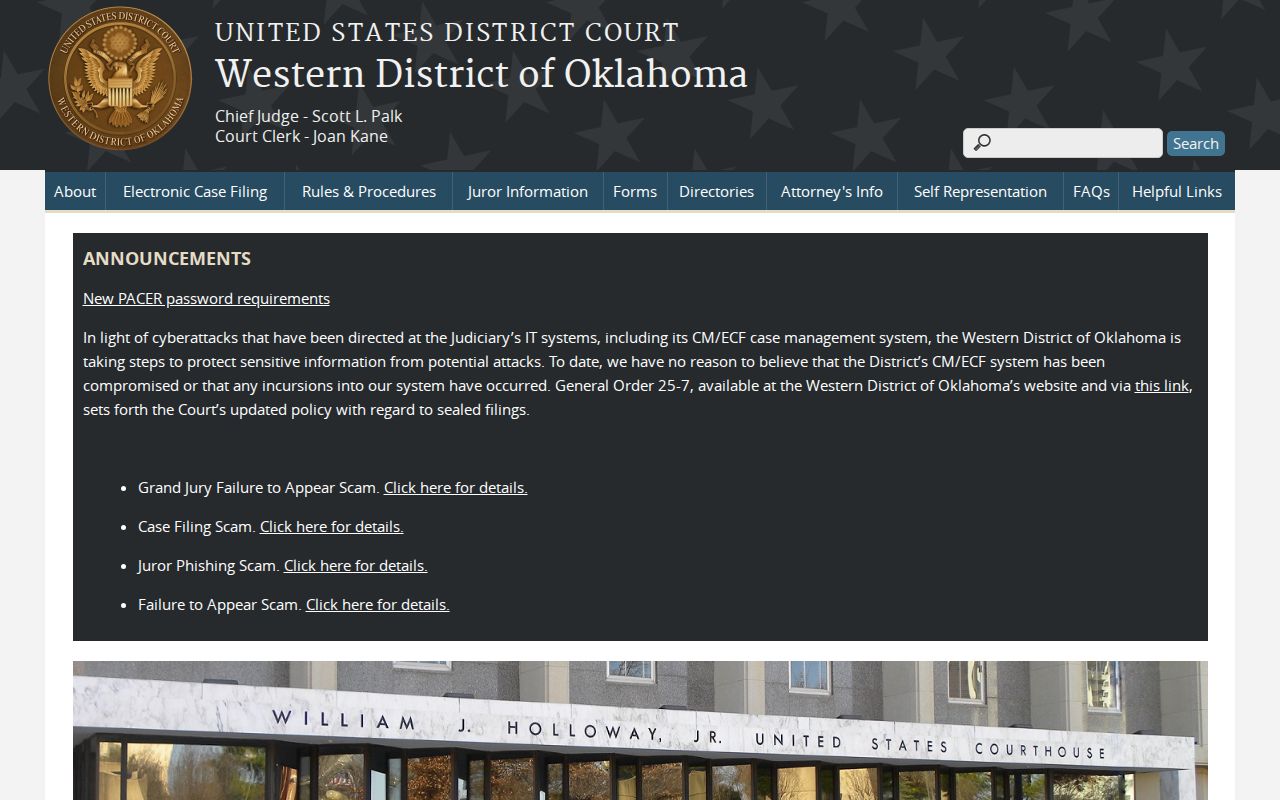
The federal source helps separate federal process from county and municipal records.
Handling an Arrest Warrant in Your Name
A warrant in your own name needs a careful first move. Call the sheriff and the issuing court, then ask counsel about a safe plan. Pin down the court, the case number, the warrant type, and the bond status. Ask where you would surrender and whether a scheduled appearance or motion is available. The sheriff can explain local process, but only the issuing court can recall or quash its own warrant. After an arrest, a bond posting, or court action in Dewey County, get the next setting in writing. Keep the order, the receipt, the bond paperwork, and the confirmation date. If the case is District Court, ask the Court Clerk whether the docket now shows the event. If it is municipal, ask the town court for its own receipt or recall proof, since Dewey County offices will not hold that record.